Kern – What started from a new material
A Fogia Journal / June 2025
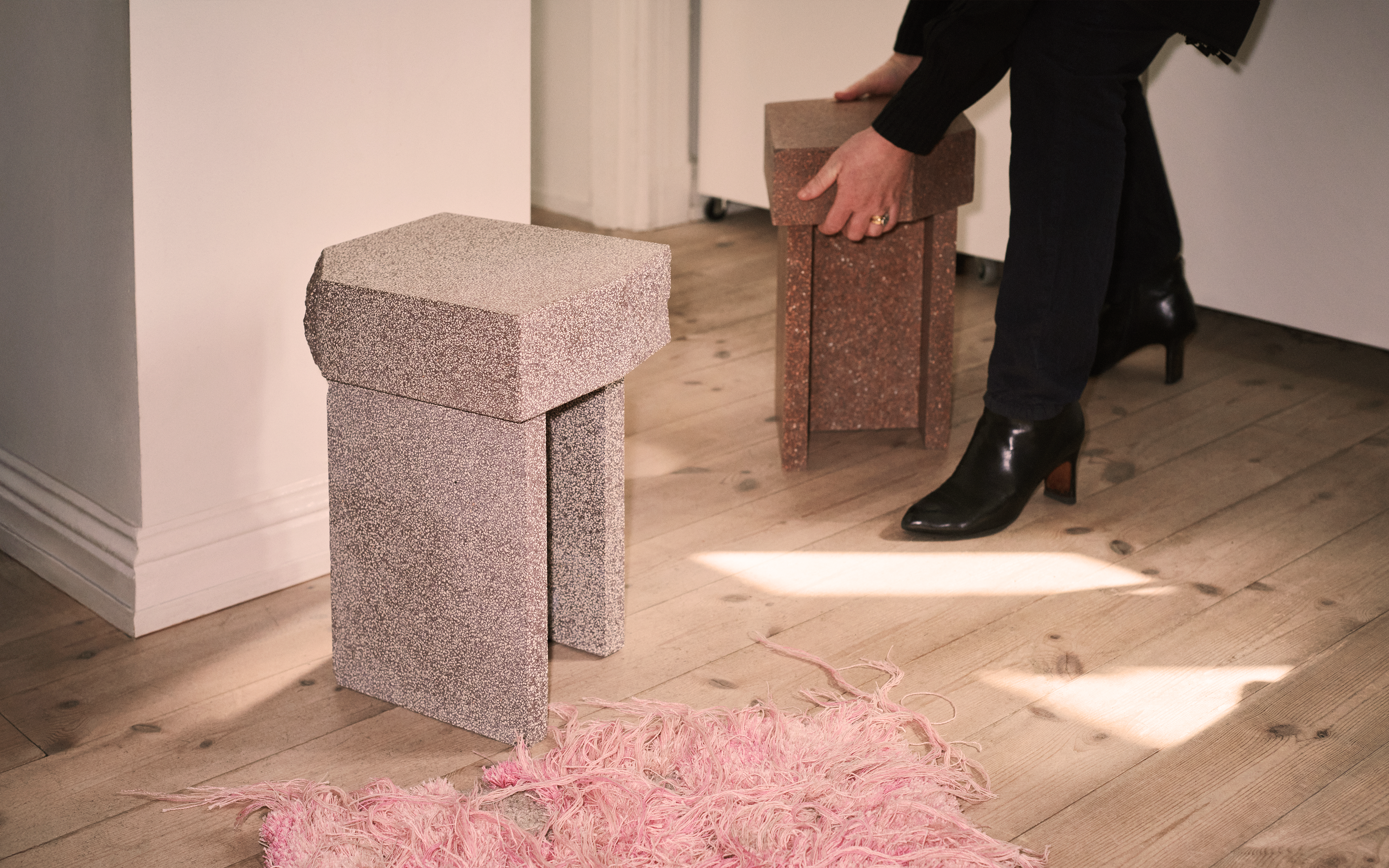
Kern is as much a sculpture as it is a table. Your eyes, as well as your hands, are drawn to it. It isn’t enough to look at Kern. You have to send your fingertips across its slightly uneven surface – brushed, rather than polished, to emphasise the material’s natural characteristics.
“This is a completely new material made from marble waste. It’s got a really fascinating appearance,” explains Förster. “We worked with the material as the project’s starting point – which is what led us to create a brutalist furniture piece. But we ended up softening that by breaking off the corners. The breaks are actually done by hand, so no two tables are exactly alike.”
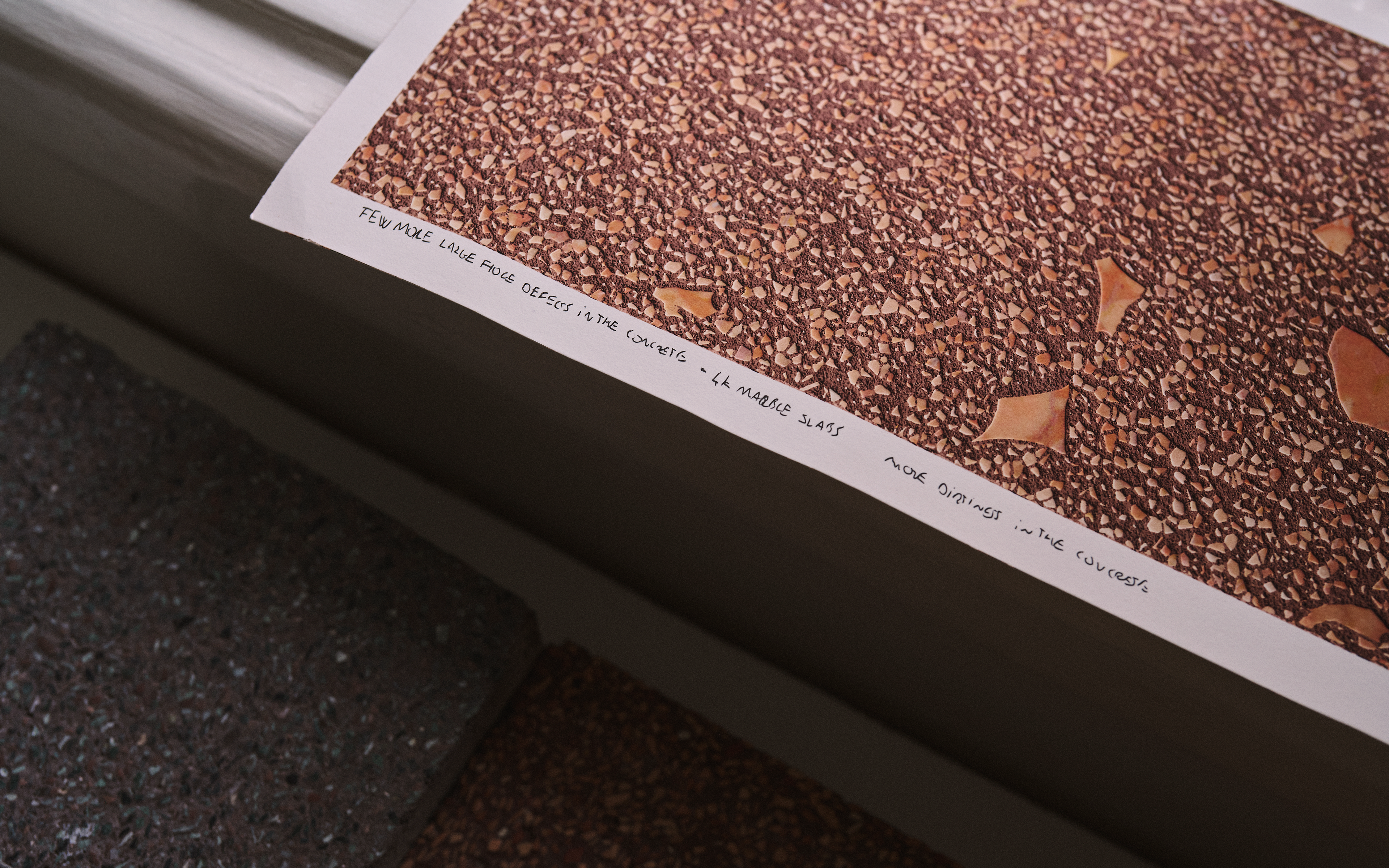
Kern is the first product to be made of Outt, a marble-based material developed with the aim of utilising waste materials from the marble quarries and producers in Northern Italy. The material is the outcome of an innovative manufacturing process that enables the re-use not only of marble chips (which have long been used to make terrazzo, for example) but also marble dust, which acts here as a binder. The result is an upcycled material with a character all its own, and whose marble content is as high as 85%, the rest being cement.
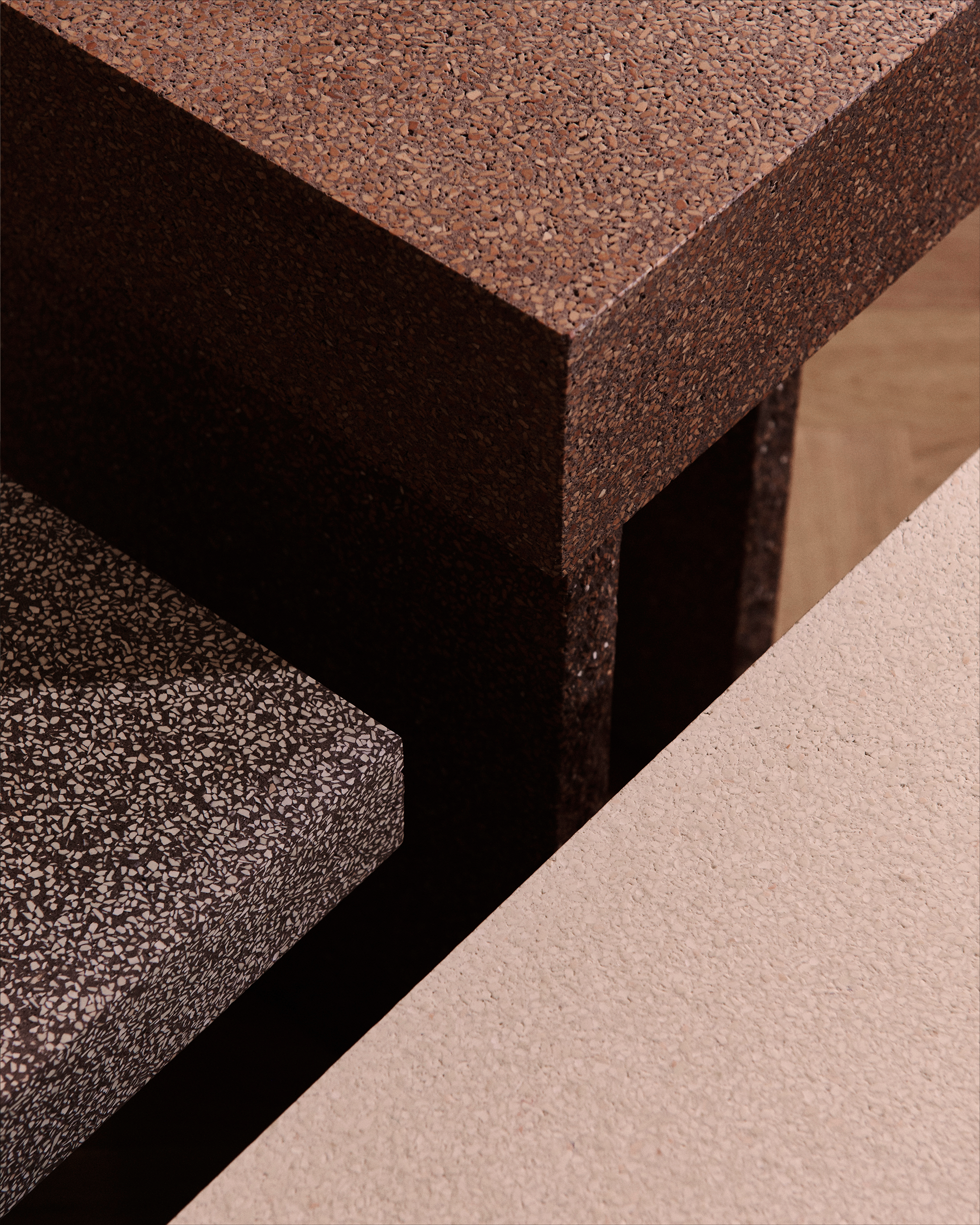
Kern is available in three colours – White, Grey and Brown terracotta.
“To me, it’s like unlocking a world within. Finding the inherent poetry of each object, so people connect with it emotionally and keep it for a long time... I think using your hands in its creation plays a big role in that poetry. It really lets the object speak to the heart.”
Monica Förster


Kern tables where it all began, in the quarry in northern Italy.
Both the side table and the coffee table are rich in contrasts. The era of their unlocked world is hard to pinpoint. It feels both contemporary and ancient. Meanwhile, the material’s weight and history contrast with the lightness and elegance of the gesture. Indeed, Kern manages to be massive, yet graceful, primitive, yet sophisticated. Associations range from prehistoric monuments to the utter simplicity and playful material exploration of Arte Povera, for example.
The tables express themselves differently depending on the perspective from which they are viewed. Seen from the side, the coffee table, for instance, is reminiscent of a character – some three-dimensional letter. Coincidence or not, this brings to mind Förster’s fascination with typography.
“Typefaces are like tiny sculptures. Their negative space is as important as their positive space. I studied typography under Carl Fredrik Hultenheim, one of the world’s most renowned typographers. He said that there were only seven typefaces worth using, and that what they had in common was that they were all cut by hand. This creates a perceptible imperfection that not only makes the typeface beautiful but also easier to read. I’ve thought a lot about that. I think the little inconsistencies in handmade objects make it easier for us to embrace them.”
Förster describes the process behind Kern as open and exploratory. The idea of breaking off the corners, for example, arose fortuitously when a material sample arrived in the same state. Just because a process is open doesn’t mean it’s aimless or haphazard. For Förster, there’s always a fundamental problem to solve, which in this case was how to interpret the material. And, after all, serendipity isn’t just about stumbling on something valuable; it’s equally about recognising and harnessing its value.
The Kern family