Fogia Factory – Furniture Making: A collaborative craft
A Fogia Journal / January 2026
Higher quality, less waste: the value of an on-site sawmill
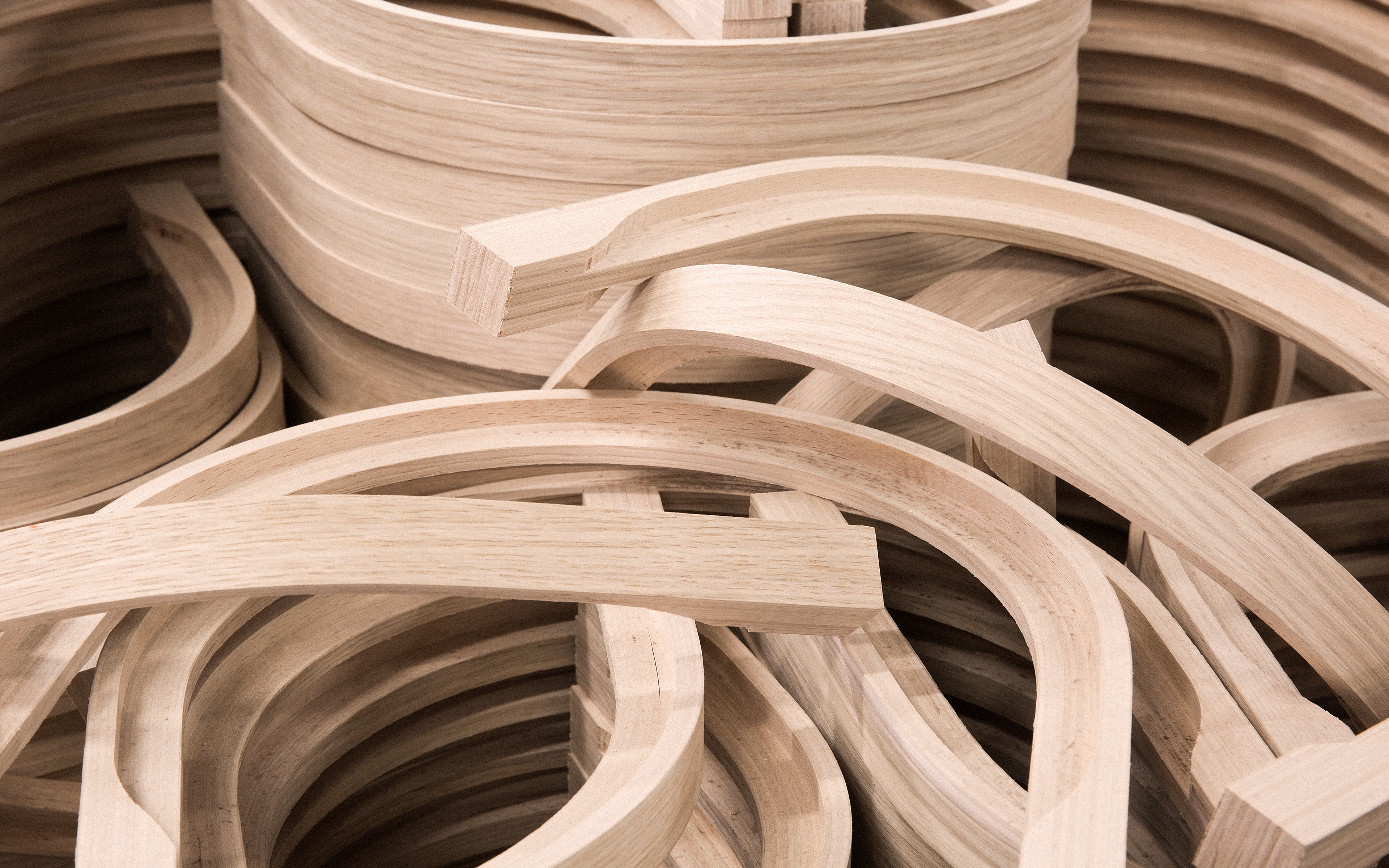
It’s often said that good food is made from scratch using whole ingredients. The same goes for furniture. That’s why Fogia’s factory includes not only woodworking shops and studios for upholstery, sewing, and cutting but its own sawmill.
Having an on-site sawmill brings its own advantages. Purchasing whole logs rather than ready-sawn planks provides access to higher-quality wood. It also removes the limitation of standard thicknesses: by sawing the timber precisely to the dimensions required, waste is significantly reduced. Even the sawdust finds a purpose – as fuel to heat the workshops.
The factory’s guiding principle is to generate as little waste as possible and to transform whatever waste is produced into a resource. This ethos extends beyond wood to encompass textiles, leather, and upholstery materials.
Piotr Mrozik, the factory’s managing director, explains that the sawing is always done in the early spring: “It’s important to saw before it gets too warm, in order to avoid the wood being attacked by rot, mould, and insects.”
Newly cut wood has a moisture content above 50%. The sawn timber is dried outdoors for between six months and two years, depending on the type of wood, until it reaches a moisture content of 20-30%. It is then kiln-dried to achieve a final moisture content below 10%, ensuring that the wood in the finished furniture neither warps nor cracks.
Beech and pine are the most frequently used woods – primarily for sofa and armchair frames – and both grow abundantly in the surrounding forests. The timber is sourced locally and never travels more than 100 kilometres.
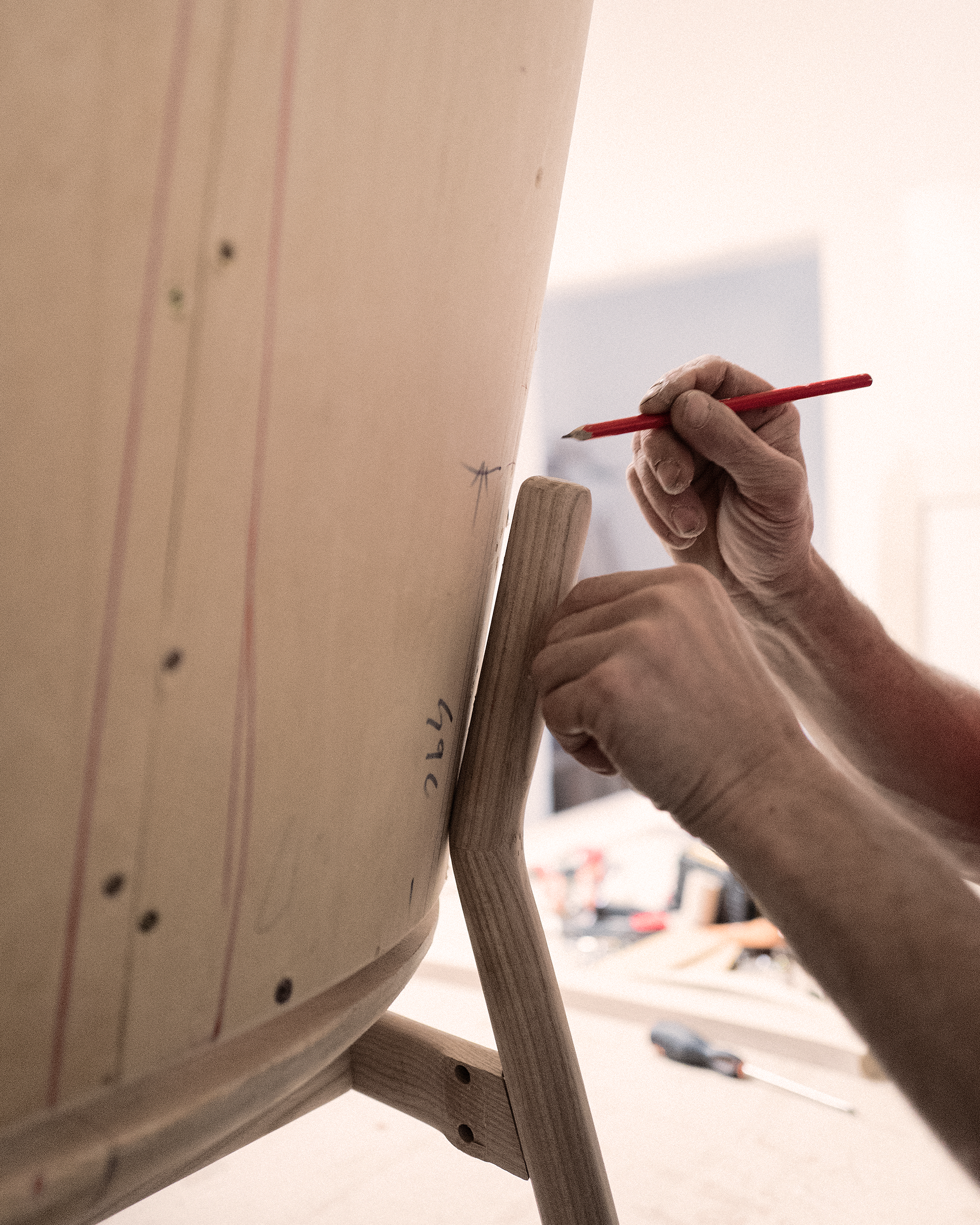
In 1993, Fogia opened its furniture factory in Poland. Today, just over 100 employees work there.
Craftsmanship clearly plays a central role at Fogia’s factory – but not for nostalgic reasons. When production volumes are large, industrial methods are naturally appropriate. Ultimately, it is the designer’s idea that determines the approach. Some designs demand extensive manual work, others less. A single standardised process would be impossible, as every furniture design is unique.

Most upholstery work is carried out by hand
The work of building furniture is demanding yet joyful. “This is due to the craftsmanship itself, but also to the good atmosphere and strong sense of togetherness within the company,” says Beata Ulenberg, manager of the upholstery department. “What we do is a team effort. And perfection is required at every step on the way to the finished product.”
Beata has worked at the factory since the very beginning, 32 years ago. She spent her first ten years as a cutter before becoming a manager. “It was my mother who got me interested in cutting and sewing,” she says with a smile. “I have to say that I love this craft. It’s the work we do with our hands that gives the furniture its soul.”
Cutting is a craft that takes years to master. The designer’s sketches or drawings are transformed into pattern pieces or templates for the cutting process. The work requires deep concentration and care – both to achieve a flawless result and to minimise waste. Over time, a cutter develops an intuitive understanding of the materials: an ability to interpret them correctly, to work with their specific properties, and to anticipate how they will behave in the finished furniture piece.
Cutting leather is particularly challenging: “Different parts of the animal’s hide have different properties. Some are more flexible than others, and some often bear marks. You simply have to understand the material, so that each part ends up in the right place on the furniture. The Tiki sofa is the most demanding product for a cutter, due to the large piece of leather used to upholster the seat.”
During a tour of the department, we meet Sabina Kuczkowska, Fogia’s head seamstress and prototype maker. When asked what characterises a highly skilled seamstress, she replies that mastering the many different stitch techniques is a given. True skill, she believes, reveals itself most clearly in what appears simplest: “The most basic thing is also the hardest. If you can sew a perfectly straight, long line, then you have what the craft demands. If the line is perfect, everything else you do will also be perfect,” Sabina maintains.


A skilled woodworker can anticipate how the material will behave
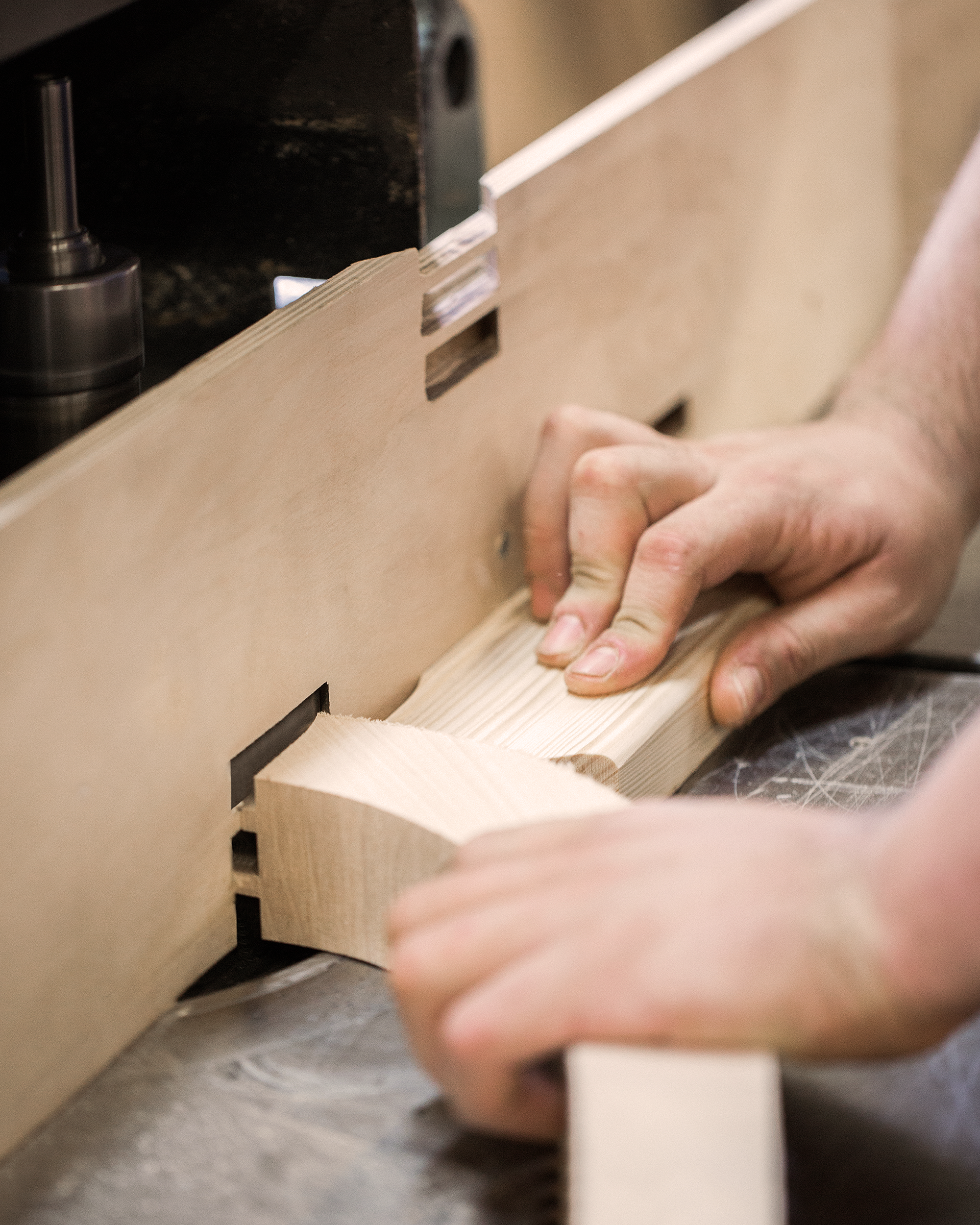
At Fogia’s factory, traditional craftsmanship and manual work at lathes and milling machines converge with CNC technology. A number of specialised tools are also used in the manufacturing process – all of them purpose-built with meticulous precision by Fogia’s woodworkers.
The carpentry shop comprises several workshops across four buildings, including a prototype workshop and a paint shop. There we meet manager Roman Zielonka and Krzysztof Golnau, foreman and CNC wood machinist.
Roman has worked at the factory for 28 years – first as a woodworker, and for the past fifteen years as carpentry shop manager. He explains that roughly half of the work is done by hand. He stresses the importance of craftsmanship and a firm understanding of materials, even in automated, large-scale production: “Regardless of what you work with here, you need a fundamental knowledge of the material. Wood is a living and changing material, whose properties vary with, for example, humidity and temperature.”
What, then, characterises a skilled woodworker? Roman believes versatility is key: “A good woodworker masters all the different machines and has an understanding of the whole. This is necessary to grasp how the different parts of a product interact.” Krzysztof adds: “Imagination is important. A skilled woodworker can anticipate how the material will behave as part of the furniture piece.”
Are any of Fogia’s designs particularly challenging? Roman points to the Figurine chair, with its gently rounded lines, numerous angles, and varied joint types, as one that demands an especially high degree of craftsmanship.
Passion is almost certainly another essential quality for becoming a truly skilled craftsperson – though the workers seldom mention it, perhaps because it feels so self-evident. But a genuinely joyful passion shines through whenever they speak of their work – not least when Roman shows us photographs of an oak cabinet he built at home. Its doors are adorned with a complex and beautiful floral pattern, carved with extraordinary precision. A piece that evidently demanded immense time and patience.
Neither Roman nor Krzysztof fears that craftsmanship will ever be replaced by machines. Some tasks must be performed by hand, as no machine could replicate them.
Roman shows us a beautiful, slightly organic-shaped oak backrest for a chair: “This backrest has to be made by hand because of its thinness. The machine can’t manage it.” He also believes that handwork imparts character – a quality unattainable in large-scale industrial production. After all, no two hand-crafted pieces are ever entirely identical.


Prototyping is a team effort
The crucial first step in any new design is determining how to translate the designer’s sketches and drawings into furniture – without compromising the core idea and while assuring the highest possible quality. As head of the Development Department, Michał Lis is responsible for this phase. “I work between production and design, as a mediator,” he explains. “You could say that my task is to visualise the designer’s ideas for the prototype makers.”
Currently, Michał is working on a new chair by designer Andreas Engesvik. The two know each other well, and Andreas is now on site with product developer Gabriel Follonier, fine-tuning the chair’s dimensions. Roman Stefański, head upholsterer and prototype maker, has already produced several prototypes in pursuit of exactly the right feel. It is a chair that must remain comfortable to sit in for several hours. For Andreas, the interaction between body and furniture is paramount – its occupant should feel perfectly at ease.
For a company that prizes ideas so highly, owning its own factory is crucial. It grants designers and prototype makers the time and space needed to bring an idea to life – an exploratory process that often requires finding new ways to solve problems. Different materials can be tested and evaluated, always with environmental considerations very much in mind. For this new chair, the ambition is to use an upholstery material made from fibres extracted from coconut shells.
“Working on a new product is always a team effort,” Michał says. “I have the pleasure of working together with very skilled people.” In addition to designers, product developers, and prototype makers, the managers of the various departments are part of the working group. For this chair, built on a thin tubular steel frame, long-time collaborator and metal frame manufacturer Karud is closely involved. Their factory is just twenty minutes away.
Craftsmanship clearly plays a central role at Fogia’s factory – but not for nostalgic reasons. When production volumes are large, industrial methods are naturally appropriate. Ultimately, it is the designer’s idea that determines the approach. Some designs demand extensive manual work, others less. A single standardised process would be impossible, as every furniture design is unique.